BEST VPN SERVICES



In today’s age, where online privacy and security are more crucial than ever, residential VPNs have emerged as a powerful tool for safeguarding your digital footprint. Websites like Ticketmaster and Shopify often block data center IPs to prevent bots from accessing their platforms. Residential VPNs, however, mimic real-user behavior by routing traffic through actual home IP addresses. This makes them indispensable for tasks like sneaker copping, ad verification, or bypassing anti-bot systems.
Unlike data center VPNs, which use servers in centralized locations, residential VPNs leverage IPs from actual devices, making them harder to detect. However, this peer-sourced model raises ethical questions, as some providers may not fully disclose how they obtain these IPs. In this article, we’ll explore the best residential VPNs, how they work, their benefits, and the legal and ethical considerations of using one.
Best Residential VPNs

- NordVPN – The best all-around VPN with top-tier security, blazing speeds, and a massive server network.
- Surfshark – Budget-friendly powerhouse with unlimited device connections and strong streaming unblocking.
- Proton VPN – Privacy-first choice with a trustworthy free plan and advanced security features like Secure Core.
- Total VPN – A simple, no-frills VPN for basic privacy and light streaming at an affordable price.
- ExpressVPN – The premium choice for speed, reliability, and effortless unblocking—best for those who want the absolute best.
How Residential VPNs Work

Residential VPNs operate by pooling IP addresses from users who voluntarily share their bandwidth. For example, apps like Honeygain and PacketStream reward users for participating in their networks. However, not all providers are transparent about their sourcing methods. Some unethical operators scrape IPs without consent, exposing users to legal risks and potential misuse of their devices.
When choosing a residential VPN, always verify how the provider sources its IPs. Ethical providers will clearly outline their opt-in policies and ensure users are compensated for sharing their bandwidth. Avoid services that lack transparency, as they may exploit devices without permission, leading to potential legal and security issues.
Top Residential VPNs
1. NordVPN

If you are looking for a residential VPN, then we can do you better and point you in the direction of a VPN that gives you the option of a dedicated IP address. The thing about a dedicated IP address is that it is going to be able to help you do everything that a residential VPN does. But it is going to be able to do it better, because NordVPN comes with so many more features.
- NordVPN is the industry leader (by a long way)
- 30-day risk-free trial
- Superfast speeds
- 7,300+ servers in 115+ countries
- Strict no-logs policy
- Next-generation military-grade encryption
- DoubleVPN, double privacy
- 10 simultaneous device connections
- Great for: Safety, security, anonymity & peace of mind
- Compatible with: Windows, Mac, Android, iPhone, iPad & iOS, Linux, routers, Apple TV, FireFox, Google Chrome, Microsoft Edge, and more
NordVPN is the most popular VPN service in the industry and comes standard with a ton of security and privacy measures, as well as customizable options. It is known for its strong security and fast speeds. With over 8,200 servers in 126 countries, it helps users browse anonymously, access geo-blocked content, and protect their data from hackers, especially useful on public Wi-Fi.
One standout feature is NordVPN’s Threat Protection, which blocks ads, trackers, and malware before they even reach your device. Independent audits confirm its no-logs policy, meaning it doesn’t store your online activity. While some VPNs slow connections, NordVPN’s NordLynx protocol maintains speed without sacrificing security.
Whether streaming, torrenting, or just staying private, it’s a solid choice, though cheaper options exist if you don’t need all the extras. If you want to learn a little bit more about them before you commit to anything, you can watch their tutorial video on the website and then sign up for a 30-day risk-free money-back guarantee.
2. Surfshark

Surfshark is a budget-friendly VPN that doesn’t compromise on features, offering strong encryption, unlimited device connections, and a strict no-logs policy. Unlike most competitors, it lets you protect every device in your household—phones, laptops, smart TVs—all under one subscription, making it great for families or heavy users.
- Surfshark is the best budget VPN
- 30-day risk-free trial
- Strict no-logs policy
- 3200+ servers in 100 countries
- Unlimited simultaneous device connections
- Great for: private browsing on a budget
- Compatible with: Windows, Mac, Android, iPhone & iOS, Linux, FireFox, Google Chrome, Microsoft Edge, and more
A unique perk is Surfshark’s CleanWeb, which blocks ads, trackers, and phishing attempts automatically. It also includes Camouflage Mode to hide VPN use from ISPs, handy in restrictive regions. While its server network (3,200+ in 100 countries) is smaller than NordVPN’s, speeds remain reliable for streaming and torrenting. Independent audits back its security claims, and its affordability makes it a top pick for value-focused users.
3. Proton VPN

Proton VPN is a privacy-focused VPN developed by the same team behind Proton Mail, offering strong security and a strict no-logs policy backed by Swiss privacy laws. Unlike many competitors, it provides a free tier with no data caps, though speeds are slower, making it ideal for light browsing.
A standout feature is Proton VPN’s Secure Core architecture, which routes traffic through hardened servers in privacy-friendly countries (like Switzerland and Iceland) to prevent network attacks. Paid plans unlock faster speeds, P2P support, and access to streaming-optimized servers.
Its extensive server network (15,000+ in 126 countries), open-source apps, and transparency reports make it a top choice for privacy purists. The free version is rare in the VPN world, but power users will want the paid plan for full features.
4. Total VPN

Total VPN is a lesser-known but solid VPN option that offers essential privacy features without overwhelming extras. It provides military-grade encryption, a no-logs policy, and servers in 60+ locations—enough for secure browsing and basic streaming. While it lacks some advanced tools, its simplicity makes it great for casual users who just want reliable protection.
One unique perk is TotalVPN’s SmartDNS, which helps unblock geo-restricted content on devices that don’t support VPNs, like smart TVs. Speeds are decent, though not as fast as top-tier rivals, and its smaller server network (around 100 servers) may cause congestion during peak times. Priced affordably, it’s a no-frills choice for light streaming and everyday privacy, but power users might miss features like split tunneling or independent audits.
5. Express VPN

ExpressVPN is the gold standard of VPNs—blazing-fast speeds, ironclad security, and unmatched reliability. With servers in 105 countries, it breezes through geo-blocks, making it a favorite for streaming Netflix, BBC iPlayer, and other stubborn platforms. Its Lightway protocol ensures minimal speed loss, so you can game, torrent, or video-call without lag.
What sets ExpressVPN apart is its trusted reputation—it’s been independently audited, operates under privacy-friendly British Virgin Islands laws, and even pioneered VPN router firmware for whole-network protection. The only downside? It’s pricey. But if you want the fastest, most secure VPN with 24/7 live chat support, it’s worth every penny. No free trial, but they offer a 30-day money-back guarantee—risk-free.
6. Tuxler

Tuxler is a community-driven service, making the most of peer-to-peer technology. It is only compatible with Mac and Windows devices. The VPN covers many United States counties and states, and various locations in Europe, and about 100 other countries. They are also known for offering tight security and never selling their users’ information to a third party.
Tuxler is a 100% residential VPN that is top-rated and has a free version. It offers users a wide range of accessibility irrespective of their location, as it allows users to access all available websites in the world without restriction. Although the unlimited accessibility, unique functionalities, and other features are only available for its paid version. The good thing is that the paid version is very cheap, meaning that anybody can have access to it.
7. Torguard VPN

Torguard VPN is a powerful paid residential VPN and one of the most popular VPNs around the world, known for bypassing high-level VPN blockades. The headquarters is located in the United States, but they cover over 50 countries around the globe with more than 3,000 servers.
Torguard VPN is unique among VPN providers because it is one of the rare services that has its servers in Korea. The tunneling protocols Torguard VPN uses include OpenVPN, L2TP/IPsec, PPTP, SSTP, and the famous next-generation IKEV2. It easily passes DNS and IP leaks tests because it uses military-grade encryption, making it one of the best residential VPNs for secure online activities.
A unique feature of Torguard VPN is that it efficiently unblocks popular streaming services, irrespective of how strict their restriction and security are. Some of the streaming services you can use to unblock include Netflix, Disney+, Hulu, BBC iPlayer, and Amazon Prime Video.
Torguard VPN is available on all the common platforms, such as Android, Windows, Linux, Mac, and iOS. It costs $9.99 monthly to subscribe to its plan, and it has an extensive collection of IP addresses that it assigns to users uniquely.
When using a Torguard VPN IP address, no other user can use it for a specified period. This gives you control and also ensures you have a massive pool of IP addresses to use for a long time. It is also prevalent for its lightning speed, making it rank as the fastest VPN in the market.
8. PureVPN

PureVPN is the comeback kid of the VPN world—once questionable, now squeaky-clean with a no-log policy certified by independent audits. With 6,500+ servers in 78 countries, it handles 4K streaming like a champ (we binged The Crown in UHD without a single buffer) and even offers dedicated IPs for banking or work use.
Here’s where it gets wild: PureVPN bundles cloud storage, password managers, and even a private email service, making it a one-stop privacy shop. Their Quantum-Resistant servers (yes, that’s a thing) future-proof your data against hacker supercomputers. Speeds? Surprisingly zippy on WireGuard, though distant servers can lag.
The catch? Past privacy scandals still haunt its rep, but the KPMG-audited zero-log policy since 2018 helps. At $1.99/month, it’s a steal—just avoid the Hong Kong servers if you’re extra paranoid. There is no free version, but a 31-day money-back guarantee, which lets you test-drive the whole suite.
9. NetflixVPN

NetflixVPN is a paid VPN for streaming online services at the cost of $5 for a monthly subscription. It has 17 server locations in about 190 countries, which include areas such as Japan, India, Canada, the United States, and the UK.
It is perfect for unblocking streaming services, especially Netflix, just as the name implies. It also unblocks over 200 other streaming services. NetflixVPN works perfectly on Windows, iOS, Android, and Mac devices. NetflixVPN offers its users next-generation connection protocols for the VPN tunnel, such as IKEV2, and other top-quality connection protocols in PPTP, SSTP, L2TP, and OpenVPN.
This VPN doesn’t provide a client or VPN software of its own, so you’ll have to configure it manually on your devices. The worrying factor when using NetflixVPN is that there is little information about its logging policy and where its headquarters are located.
It also doesn’t provide users with VPN software or client software. This implies that users will have to configure it on their devices manually, but more importantly, they have to be careful when using this VPN.
10. Mysterium VPN
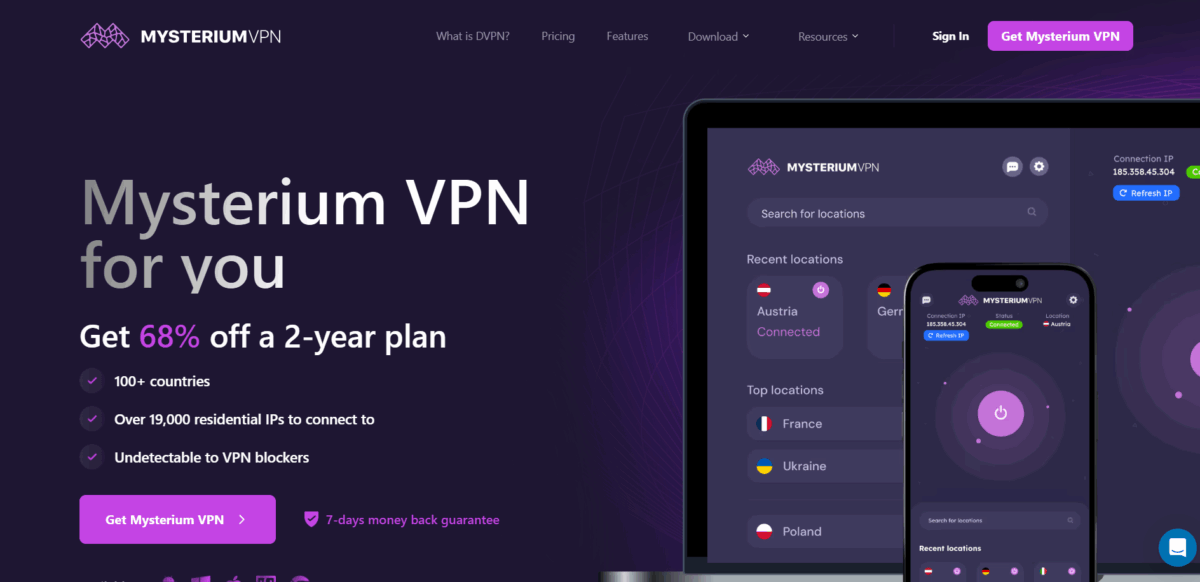
Mysterium VPN is a decentralized VPN service that prioritizes privacy, security, and unrestricted internet access. Unlike traditional VPNs that rely on centralized servers, Mysterium operates on a peer-to-peer network, allowing users to share and sell their unused bandwidth in exchange for cryptocurrency. This decentralized approach enhances anonymity by eliminating single points of failure, making it harder for third parties to track or censor user activity.
With no-logs policies and strong encryption, Mysterium ensures that your online traffic remains private, whether you’re bypassing geo-restrictions, securing public Wi-Fi connections, or protecting sensitive data.
One of its standout features is its pay-as-you-go model, which allows users to pay only for the bandwidth they consume, offering a cost-effective alternative to subscription-based VPNs. Built on blockchain technology, the platform uses its native MYST token for transactions, fostering a transparent and incentivized ecosystem.
Whether you’re a privacy-conscious individual, a frequent traveler, or a supporter of decentralized web solutions, Mysterium VPN provides a flexible and secure way to browse the internet without compromising speed or accessibility. Its global network of nodes ensures reliable connections, making it a strong contender in the next generation of privacy tools.
11. CyberGhost

CyberGhost doesn’t shout about its features—it just quietly gets the job done with zero fuss. This isn’t some bare-bones budget VPN, though; it’s packed with smart automation that makes private browsing effortless. The moment you hit “streaming mode,” it instantly connects you to the perfect server for Netflix, BBC iPlayer, or whatever else you’re binging—no tech skills required.
What stands out is its residential IP network, which makes your traffic look like regular home internet use. Ever noticed how some websites block VPNs? CyberGhost sidesteps that completely. Their NoSpy servers take it further with military-grade security, while the “Smart Rules” feature lets you create custom auto-connect triggers (like always using a Swiss server for banking).
Sure, it’s not the absolute fastest or most hardcore privacy tool out there—but for $2.19/month with a 45-day money-back guarantee, you’re getting shocking value. The Windows app even includes a free ID guard to alert you about data leaks.
12. Private Internet Access

Private Internet Access (PIA) is like that reliable old pickup truck—it might not turn heads, but it’ll haul anything you throw at it without breaking a sweat. With a ridiculous 35,000+ servers across 91 countries, you’ll never fight for bandwidth, even when torrenting massive files or gaming at peak hours. The company walks the privacy talk too—they’ve twice proven in court that they keep zero logs, and their open-source apps let nerds like us verify every line of code.
Here’s the kicker: While it looks like something from the Windows XP era, PIA packs next-gen WireGuard support (via their “NextGen” network) and RAM-only servers that wipe data on reboot. The MACE feature nukes ads/trackers system-wide, and you can even pay with McDonald’s gift cards if you’re paranoid about anonymity. Yeah, streaming-unblocking can be hit-or-miss compared to ExpressVPN, but at under $2.03/month for 10 simultaneous connections? This is the VPN you buy when you’re done with flashy marketing and just want raw, audited privacy power.
13. Private VPN

PrivateVPN is a reliable residential VPN that offers strong encryption, decent speeds, and a strict no-logs policy, making it a good choice for privacy-conscious users. While its server network is smaller compared to top competitors, it provides dedicated residential IPs and solid unblocking capabilities for streaming platforms like Netflix and BBC iPlayer.
The service supports P2P traffic, making it suitable for torrenting, and its user-friendly apps are ideal for beginners. However, its limited server locations and occasional speed drops keep it from ranking higher on our list. One of PrivateVPN’s biggest draws is its affordability, with competitive pricing and a 30-day money-back guarantee. It allows up to 10 simultaneous connections, which is generous for a mid-tier VPN.
Customer support is responsive, though live chat isn’t available 24/7. While it covers the basics well, power users may miss features like split tunneling or obfuscation. For those seeking a budget-friendly residential VPN with solid security, PrivateVPN is a decent pick, but more demanding users may prefer higher-ranked alternatives.
14. AstrillVPN

Astrill VPN is a premium service known for its high-speed connections, strong security features, and ability to bypass strict geo-restrictions in countries like China and the UAE. It offers dedicated residential IPs, advanced encryption, and a strict no-logs policy, making it a solid choice for privacy-focused users. However, its biggest drawback is its steep pricing, which places it among the most expensive VPNs on the market. While it delivers excellent performance and reliability, the cost may deter budget-conscious users.
Astrill VPN stands out with features like multi-hop VPN (RouterChain) and customizable security settings, catering to advanced users. Its speeds are consistently fast, and it works well with streaming platforms like Netflix and Hulu. However, the interface can be overwhelming for beginners, and the limited device support (only five simultaneous connections) is disappointing at this price point. If you need a VPN that works in heavily censored regions and don’t mind paying a premium, Astrill is a strong contender, but more affordable options offer similar performance for everyday use.
15. iProVPN

iProVPN is an affordable residential VPN that offers decent speeds, strong encryption, and a no-logs policy, making it a viable choice for casual users. It provides dedicated IP options and works with some streaming services, though its unblocking capabilities aren’t as consistent as top-tier competitors. The service supports P2P traffic, making it suitable for light torrenting, and its user-friendly apps are great for beginners. However, its small server network and occasional connectivity issues prevent it from ranking higher.
With competitive pricing and a 30-day money-back guarantee, iProVPN is an attractive option for cost-conscious users. It allows up to 10 simultaneous connections, which is generous for its price range. Customer support is available, but not as responsive as premium VPNs. While it covers essential privacy needs, it lacks advanced features like split tunneling or obfuscation. If you’re looking for a simple, budget-friendly residential VPN, iProVPN is worth considering—but power users may find it too limited.
Benefits of Residential VPNs

Beyond bypassing blocks, residential VPNs are invaluable for niche applications. For instance, e-commerce companies use them to monitor competitors’ region-specific pricing without triggering anti-scraping mechanisms. Similarly, SEO professionals rely on residential IPs to track localized search rankings accurately, while social media managers use them to automate campaigns without getting flagged.
However, residential VPNs come with trade-offs. They tend to be slower than data center VPNs due to their reliance on home networks, making them less ideal for bandwidth-intensive tasks like streaming. Additionally, they are often more expensive, as maintaining a pool of residential IPs is costlier than operating data center servers. For tasks requiring undetectable IP rotation, though, the benefits far outweigh the drawbacks.
Legal and Ethical Considerations

Using residential VPNs comes with significant legal and ethical considerations. In regions like the EU, unauthorized data scraping can violate GDPR, leading to fines of up to 20 million euros or 4% of global revenue. Even in less regulated areas, scraping private data without consent can result in lawsuits or bans.
Ethical providers like Honeygain and PacketStream obtain explicit user consent and reward participants for sharing their bandwidth. In contrast, shady operators may exploit devices without permission, putting users at risk of legal action. Always verify a provider’s consent framework and avoid services that lack clear agreements.
FAQs
What is a Residential VPN?
A residential VPN is a virtual private network that works by routing users’ internet traffic through a different IP address. Residential VPNs are the type of VPNs that channel and redirect requests via residential IP addresses made available by Internet Service Providers (ISPs).
They provide users with a higher level of anonymity when compared to a conventional data center VPN. Residential VPNs are fast becoming one of the most promising and reliable prospects to bypass cyberspace restrictions. They ensure that users can perform their activities on the internet more efficiently and quickly. Their anti-spam evasion techniques are also better than those of the conventional data center VPNs and are a more preferred choice by VPN users.
Why to Use Residential VPNs?
Just like conventional VPNs, residential VPNs also help to hide your location. They mask your IP address but give you a different IP address, which is that of an internet service provider from a different geographic location. With this, users can surf the Internet freely without getting blocked or restricted, unlike traditional VPNs.
Irrespective of the service you are looking to access, residential VPNs will get you through it. They also offer top-quality privacy, making it difficult for people online and even the government or your internet service provider to find out your location. Residential VPNs also protect you from phishing attacks from malicious websites, ads, and bugs. Users of residential VPNs also have strong protection against the loss or theft of vital information such as saved passwords, browser history, and banking information.
Are Residential VPNs Legal?
Yes, residential VPNs are 100% legal unless the part of the world you reside in restricts their usage. In general, the use of all types of VPNs is legal in almost all countries worldwide. However, the intention of the user can be illegal or legal. Therefore, before using a VPN, consider the purpose of use. If the objective is unlawful and you are caught, no one would blame the illegal activity on the VPN Company.
How to Get a Free Residential VPN Service
In case you are new to the use of VPNs, you should be aware that you can get free residential VPNs from many providers and sources. You can visit your Chrome store, App Store, or Play Store and download a free VPN. Once you register with the VPN providers, you have access to their services. Some VPN providers do not have an app, meaning you will have to set it up manually or register on their website.
What is the Difference Between Residential VPN over Conventional Data Center VPN?
Residential VPNs offer all the benefits that a regular VPN provides. Users can enjoy complete security, anonymity, and online protection for their information and identity. However, residential VPNs still offer some advantages over conventional data center VPNs.
Just exceptionally few traditional centers of data VPNs can provide exceptional and out-of-the-box services, unlike most residential VPNs. Here are some of the differences between residential VPNs and traditional data center VPNs:
• Legitimacy: Residential VPNs offer more legitimacy when compared to conventional data center VPNs. This is because they have internet service providers to provide their IP addresses directly, unlike the cloud server IP addresses that the traditional data center VPNs use.
• Cost: Most residential VPNs are free, and so are the IP addresses offered to users. Whereas, with the conventional data center VPNs, you have to pay top dollar to subscribe to most of their plans. Also, if the cost of purchasing a paid residential VPN is compared to that of conventional data center VPNs, there is a significant difference, as the residential VPNs are cheaper.
• Speed: Residential VPNs are at a disadvantage when it comes to speed because conventional data center VPNs are always faster. The reason for this is that residential VPNs use a small server network, which will not offer users high-speed connections.
If having access to a great speed connection is one of your reasons for using a VPN, getting a VPN with residential IPs might not give you the best results.