


Crypto prop firms give traders a way to access larger capital without a huge personal account.
Each firm has different rules, profit splits, account sizes, platform options, and payout terms, so the right choice depends on your strategy and risk control.
Some firms suit active crypto traders who want flexible markets, while others fit traders who prefer simple rules and steady account growth.
In this guide, we’ll look at Mubite, FunderPro, Blueberry Funded, DNA Funded, and SabioTrade.
Top Crypto Prop Firms
Crypto prop firms can differ a lot once you check markets, payout rules, drawdown limits, and platform access.
Here are five firms that crypto traders may want to compare before they buy an account.
1. Mubite
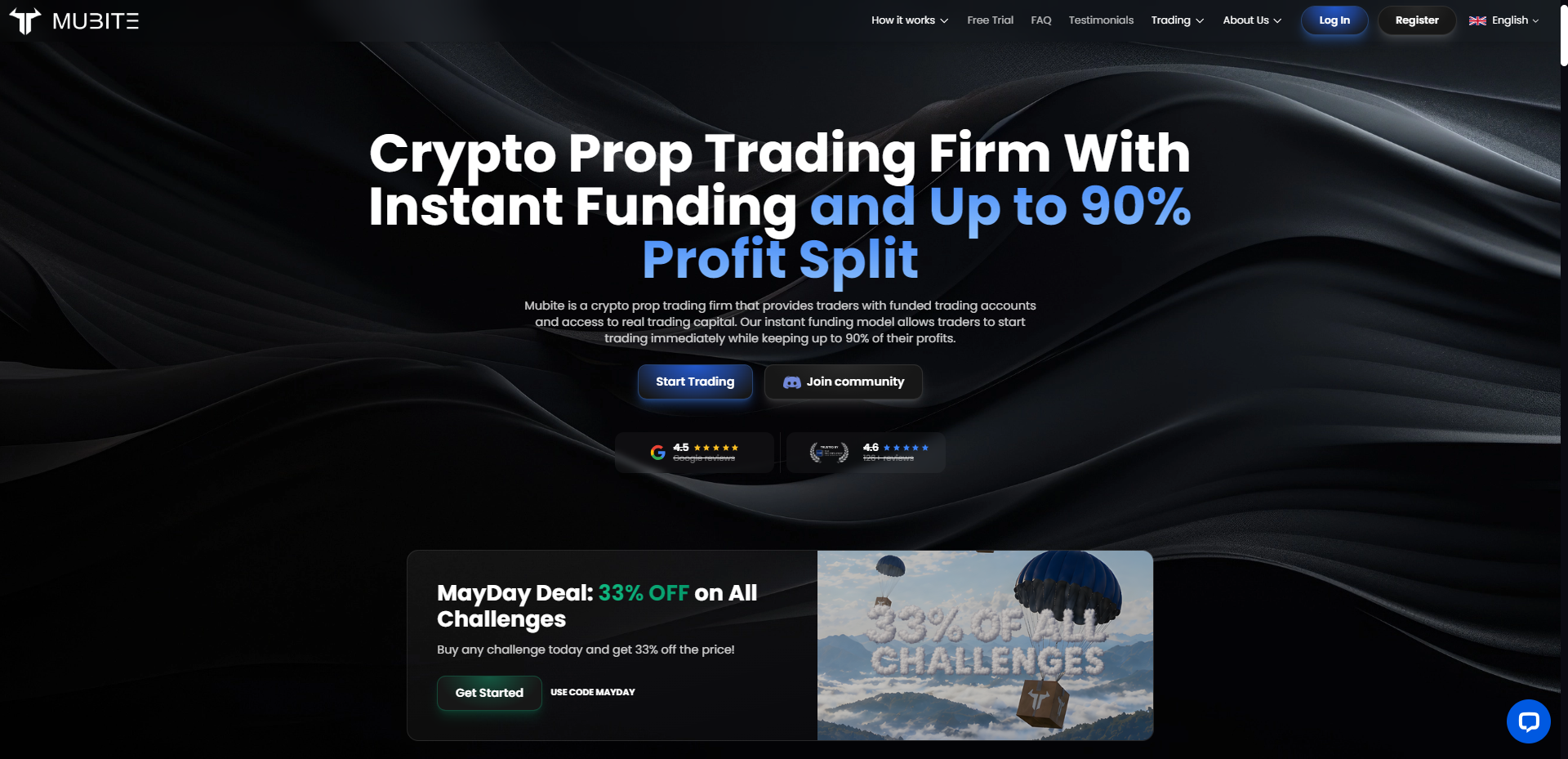
Mubite is one of the cleaner options for traders who want a crypto-first prop firm rather than a forex firm that only adds a few crypto pairs.
It gives traders access to 700+ crypto pairs through Bybit, with account sizes up to $200,000 and a scaling path that can reach $1,000,000.
Mubite has Instant Funding, One-Step, and Two-Step programs, so traders can pick between speed and lower challenge pressure.
Rules also stay fairly direct, with up to 90% profit split, 5% daily drawdown, 8% to 10% max drawdown, and 1:100 crypto leverage on challenge accounts.
Payout timing depends on account type, so traders should check it before purchase.
Pros
- 700+ crypto pairs through Bybit
- Up to 90% profit split
- Instant Funding, One-Step, and Two-Step options
Cons
- Instant Funding starts with a lower base profit split
2. FunderPro

FunderPro works better for traders who want crypto as part of a wider multi-asset account.
It offers crypto pairs such as BTCUSD, ETHUSD, SOLUSD, XRPUSD, DOGEUSD, ADAUSD, BCHUSD, DOTUSD, and XLMUSD, along with forex, commodities, indices, and stocks.
The firm lists profit splits up to 90%, unlimited challenge duration, 5% max daily drawdown, 10% max overall drawdown, and reward access on demand or weekly, depending on the account type.
FunderPro also has a 20% margin rule on funded accounts per asset class, so crypto traders cannot overstack risk across the same asset group.
News rules and weekend rules also matter, especially for swing traders who hold positions longer.
Pros
- Crypto, forex, stocks, indices, and commodities
- Up to 90% profit split
- Unlimited challenge duration
Cons
- Funded accounts have a 20% margin rule per asset class
3. Blueberry Funded

Blueberry Funded suits traders who want a simple profit split and several platform options. The firm lists an 80% profit split on Instant Access Sim accounts, with a $100 minimum payout threshold and no listed payout caps for that account type.
Third-party firm data also shows Blueberry Funded offers MT4, MT5, TradeLocker, and DXtrade, with crypto available beside forex, indices, and commodities.
Rules can vary by plan, so traders shouldn’t treat every account the same. Some challenge models use 10% targets, 4% to 5% daily loss limits, and 6% to 10% max drawdown.
Crypto traders should also read the newer prohibited strategy policy because HFT and external hedging stay restricted.
Pros
- 80% profit split on Instant Access Sim accounts
- $100 minimum payout threshold
- MT4, MT5, TradeLocker, and DXtrade options
Cons
- Rules can change by account type, so comparison takes extra care
4. DNA Funded
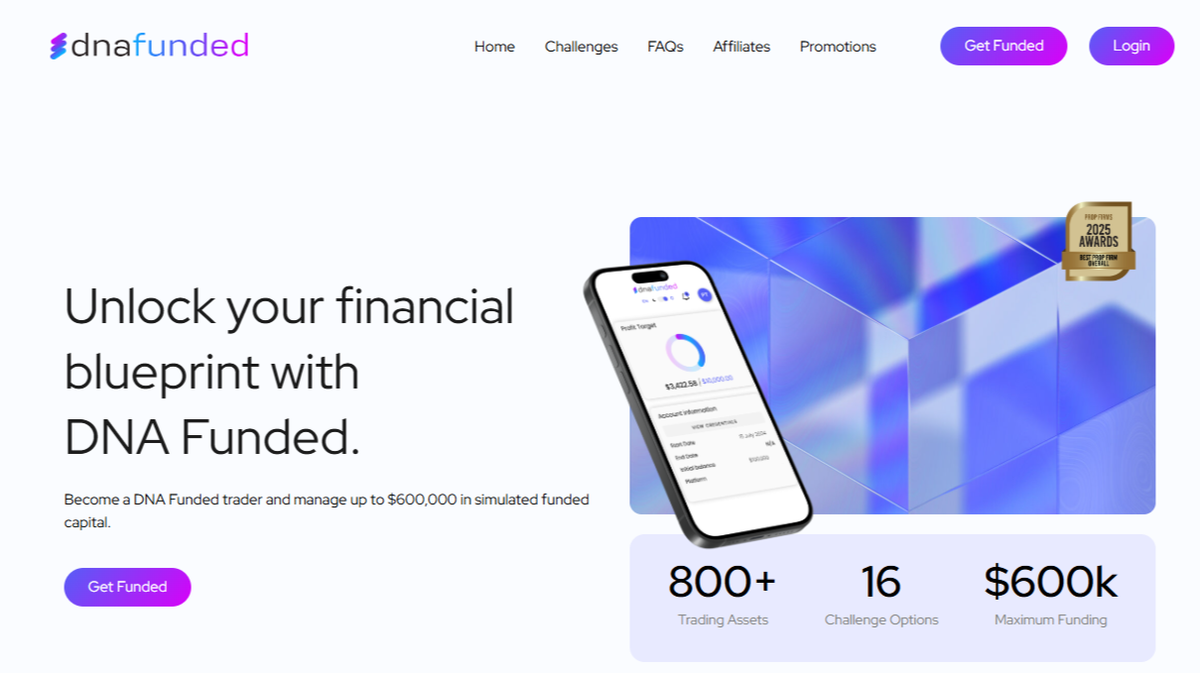
DNA Funded gives crypto traders several account paths, with 1 Phase, 2 Phase, Rapid, and Instant Funding options.
Its official site lists account sizes between $5,000 and $200,000, with leverage up to 1:50 and profit split up to 90% through add-ons.
The 1 Phase model lists a 10% profit target, 4% max daily loss, and 6% max total loss, while the 2 Phase model lists 8% and 5% profit targets across both steps.
Rapid accounts use a 5% target, 3% daily loss, and 5% max total loss.
Crypto commission sits at 0.01% of trade volume when a position opens, so active traders should include fees in their plan.
Pros
- 1 Phase, 2 Phase, Rapid, and Instant Funding options
- Up to 90% profit split with add-on
- Crypto commission listed at 0.01% of trade volume
Cons
- Higher profit split requires an add-on
5. SabioTrade

SabioTrade fits traders who want a simple one-step prop firm setup with crypto included beside other markets
Its funding page lists accounts that range from $20,000 to $650,000, profit share up to 90%, and a free trial account with no credit card required.
The Essential account starts at $20,000 with 80% payout and 1:30 leverage, while larger accounts can move to 90% payout.
SabioTrade can suit traders who dislike multi-phase challenges because the offer focuses on one assessment before access to a funded account.
Crypto traders should still compare exact symbols, spreads, and platform conditions inside the dashboard before they pay, since trade cost can matter a lot on BTC, ETH, and high-volatility altcoin pairs.
Pros
- One-step style funding path
- Funded accounts up to $650,000
- Free trial account available
Cons
- Smaller accounts start with 80% payout, not 90%
| Firm | Account Style | Crypto Fit | What to Check First |
| Mubite | Instant Funding, One-Step, Two-Step | Best for traders who want a crypto-first setup | Payout timing by account type |
| FunderPro | Multi-asset challenge accounts | Good for traders who trade crypto plus forex or indices | Margin rule on funded accounts |
| Blueberry Funded | Challenge and instant-style options | Good for traders who want several platforms | Rule differences between account types |
| DNA Funded | 1 Phase, 2 Phase, Rapid, Instant Funding | Good for traders who want flexible account paths | Add-on cost for higher profit split |
| SabioTrade | One-step style assessment | Good for traders who want a simple process | Crypto symbols, spreads, and platform conditions |
What to Check Before Choosing a Crypto Prop Firm
Crypto prop firms need extra care because crypto markets move fast, trade all week, and often have wider spreads than forex pairs.
Before you buy any account, check the rules that affect real trading, not only the account size or profit split.
Crypto Pair List
Check how many crypto pairs the prop firm gives you and which ones matter for your strategy. Some firms only offer BTC, ETH, XRP, SOL, and DOGE, while others offer hundreds of altcoin pairs.
A larger pair list helps active crypto traders, but only if spreads and execution stay stable during high-volume periods.
Payout Rules
Read the payout page before you start the challenge. Look for the minimum payout amount, payout cycle, profitable day rules, consistency limits, and profit split.
A firm may advertise 90% profit share, but traders still need to meet account balance rules, minimum day rules, or payout caps before any reward request.
Weekend Trading
Crypto trades all week, but prop firms may not allow every weekend setup.
Some firms allow weekend holds, while others may limit trades during low-liquidity periods or special market conditions.
Weekend gaps, thin order books, and sudden news can move BTC or ETH fast, so rule clarity matters a lot here.
Leverage Limits
Crypto leverage can help small moves produce larger profits, but it can also drain the daily loss limit quickly.
A 1:50 crypto account gives much more room than a 1:5 account, but higher leverage does not mean safer trading. Match leverage with your stop-loss size and average trade risk.
Platform Costs
Platform choice affects speed, chart quality, order entry, and trade management. MT5, TradeLocker, DXtrade, Bybit-based access, and custom dashboards all feel different during fast crypto moves.
Check if data, commissions, spreads, swaps, or platform fees apply because small costs can reduce profit after many trades.
Frequently Asked Questions
Can You Trade Crypto Prop Firms With A Small Account?
Yes.
Many crypto prop firms offer smaller accounts near $5,000, $10,000, or $25,000.
A smaller account can help newer traders learn the rules with less pressure, but the payout cap and drawdown limit may also be lower, so position size needs extra care.
Do Crypto Prop Firms Allow Bots?
Some crypto prop firms allow trade automation, but many restrict high-frequency bots, latency arbitrage, copy trading, and external signal abuse.
Traders should always check the prohibited strategy page before they connect any bot, script, trade copier, or exchange-based automation tool.
Is Crypto Prop Trading Harder Than Forex Prop Trading?
Crypto prop trading can feel harder because BTC, ETH, and altcoins can move sharply outside normal market hours.
Forex pairs usually have more stable sessions, while crypto can react fast to exchange news, ETF updates, liquidation events, or sudden weekend volatility.
What Is The Safest Way To Start With A Crypto Prop Firm?
Start with a lower account size and risk around 0.25% to 0.5% per trade until you understand the platform and drawdown rules.
Micro position size matters more than a large profit target because one oversized BTC or SOL trade can break the account before the strategy has time to work.