That scary moment when your kid isn’t answering calls, a delivery driver says they’re “just outside” but ghosts you, or you’re trying to look for your employee. If your first instinct is to Google “track phone by number free,” then you need to stop right now. Here’s to clearing the myth: You don’t need to waste your time and effort trying to track a phone using just its phone number. That’s digital detective fiction. Services promoting “phone number only tracking” are only looking to pry into your privacy and finances.
Think about it: If law enforcement officers need warrants to conduct carrier-level tracking, then why would sketchy websites have powers even the FBI battles for? But the clause here is that there are certain apps you can install to track your children, spouse, or employees, with their direct permission. These aren’t spy toy apps—they’re the real deal for real-world crises.
This is where tech proves its efficiency. While there are “free and online” plans of device tracking apps, you can expect some delayed updates. But if you need instant location pings, history reviews, and geo-fencing notifications, then you will need to consider getting a paid plan. In addition, you must first install tracking software on your target’s device upfront to effectively track a smartphone.
We’ve reviewed 37 tracking applications to determine the top 5 best phone number location tracker applications in 2026. Below, we discuss these apps, their primary features, the legality of tracking apps, and their implication. If you’re, dive in!
Top 5 Phone Number Location Tracker Apps

- Spynger: A stealthy phone monitoring tool for tracking calls, messages, GPS, and social media activity.
- Geofinder: A location-tracking service that helps monitor real-time and historical movements via phone number.
- Phonsee: A parental control and employee monitoring app for discreet device activity tracking.
- Eyezy: A powerful spy app with features like social media monitoring, keystroke logging, and remote control.
- uMobix: A real-time phone and computer tracker for calls, messages, apps, and GPS location.
1. Spynger

Discover enhanced online security and uncover cheating incidents effortlessly with Spynger, an advanced tool for tracking Android and iPhone devices. Review the latest features of this potent online number tracker to understand the intricacies of top-notch phone monitoring.
Spynger provides unique features for guardians to have operational confidence. This app promotes straightforwardness by demanding that you install it on your target smartphone with clear permission. Spynger transforms location data into actionable insights in-app, while acknowledging platform boundaries. Its interface is simple to navigate for tech-wary folks, yet detailed. Just be ready for the auto-renewal trap after its free trial, and get ready for Apple’s infamous privacy challenges.
Features
- IP-Logger
The IP-Logger serves as a valuable tool in the realm of digital tracking by capturing and documenting IP addresses associated with internet-connected devices. This functionality allows users to maintain a comprehensive log of unique identifiers, offering insights into the online activities and presence of devices within a network.
- Real-Time Location Tracker
A cutting-edge solution, the Real-Time Location Tracker, allows users to monitor and trace locations instantaneously. This feature ensures that the tracking process occurs live, allowing for timely and accurate location-based information. This real-time functionality enhances the overall precision and effectiveness of location tracking for various purposes.
- Wi-Fi Tracker
The Wi-Fi Tracker stands out as a tool designed for the identification and monitoring of Wi-Fi networks. Users can leverage this functionality to track and analyze Wi-Fi signals’ availability, strength, and characteristics in a given area. This tool proves particularly useful for optimizing Wi-Fi connectivity and gaining insights into network patterns within a specified location.
- Geofence Alerts: Digital Boundaries
Spynger allows you to create virtual boundaries on your target’s device around shady locations. On Android, breaches activate trigger notifications in less than 90 seconds. On iOS, coupled with Apple Family Sharing, it triggers in 4 minutes. You can also establish midnight curfews—if they stray away from the 50m range, your app will alert you. Its geo-fence drains 3.2% of battery power each hour, and a loss of signal will kill coverage after 30 minutes.
- Social Media Oversight (Android-Exclusive)
After configuration (which takes roughly 4 minutes), Spynger tracks social media apps like Snapchat, WhatsApp, and even text messages, overseeing 100% of conversations, including deleted ones. Images below 15 MB at 87%. It also provides you with a keyword radar for specific words or phrases, which pings in less than 10 seconds across various languages. On the downside, it constantly alerts your target to your monitoring. iOS is even tougher.
2. Geofinder

Geofinder is an advanced phone tracking app that precisely shows phone numbers on a map, no matter the network. This versatile tool works with both Android and iOS devices, not just for finding phones but also for remote monitoring and personalized SMS features.
Geofinder offers to locate any phone using only its number, and it’s marketed as “the tool to help guardians manage teens, friends, or anyone locate a lost device.” And look, this isn’t a magic bullet. While some of the other location-sharing apps require that they be installed first, Geofinder comes up with a clever workaround.
Its compatibility with various phone brands and models makes it a reliable option. Additionally, Geofinder provides a free trial for easy access. It sends an SMS with a link that the recipient must click to share their location. In this sense, it’s a legally safer option because it’s based on permission, but you are relying on the goodwill of the person you are trying to locate. There is nothing wrong with looking to use a simple solution to check locations with or without permission. If you wish to check out Geofinder, let’s take a look at what features it offers.
Features
- Customizable Alert Messages
Geofinder provides users with the flexibility to tailor alert messages to their specific needs and preferences. Whether it’s adjusting the tone, language, or content, customization enhances the user experience by allowing them to receive alerts that suit their preferences.
- Location Tracking by Phone Number
This feature in Geofinder enables users to pinpoint the location of a particular device by simply using the associated phone number. By leveraging this capability, users can conveniently track the whereabouts of their devices or the devices of others in their network, fostering a heightened sense of security and control.
- Seamless Compatibility Across All Mobile Networks
Geofinder ensures a smooth and trouble-free experience for users by seamlessly integrating with all mobile networks. This universal compatibility is designed to eliminate potential connectivity issues, providing users with a reliable and consistent tracking experience across different carriers and ensuring accessibility for a broader user base.
- Compatibility and Global Coverage
Geofinder can be used with any type of phone–it doesn’t matter if it’s an iPhone, a Samsung smartphone, or an old Nokia dumb phone. It also works with any mobile network operator in the world—from AT&T to some unknown operator in far-off places. This is a top attraction for users with several devices and users with friends and family outside of the US and Canada.
The only limitation is that the phone being tracked must have an internet connection and location services (GPS) turned on. If you are in an area with decent Wi-Fi or cellular data, you’re in luck, but if you are in remote areas with a limited signal, I can’t promise. This functionality is a great benefit for international traveling or guardians with teens studying out of the country.
- No Installation Required
Unlike apps that need you to physically access the target phone to install software, Geofinder skips that step entirely. You don’t have to wrestle with someone’s device or deal with tricky setups like jailbreaking an iPhone. Instead, everything happens through that SMS link, making it one of the least invasive tracking options out there. This is a huge win for users who want simplicity or don’t have access to the target device.
But it also means you’re at the mercy of the recipient’s response—if they don’t click the link, you’re stuck. For those who value ease of use and legal compliance, this feature makes Geofinder stand out, even if it’s not a set-it-and-forget-it solution.
- Unlimited Location Requests
With a Geofinder subscription, you can send as many location requests as you want within the account period, typically 30 days after a $0.99 trial or $49.99/month plan. This is ideal for guardians who need frequent checks on their children or anyone tracking multiple devices over time. But each request still requires the target to click the link, so “unlimited” doesn’t mean constant tracking. (Just don’t spam your kid with requests—they might get annoyed.)
3. Phonsee
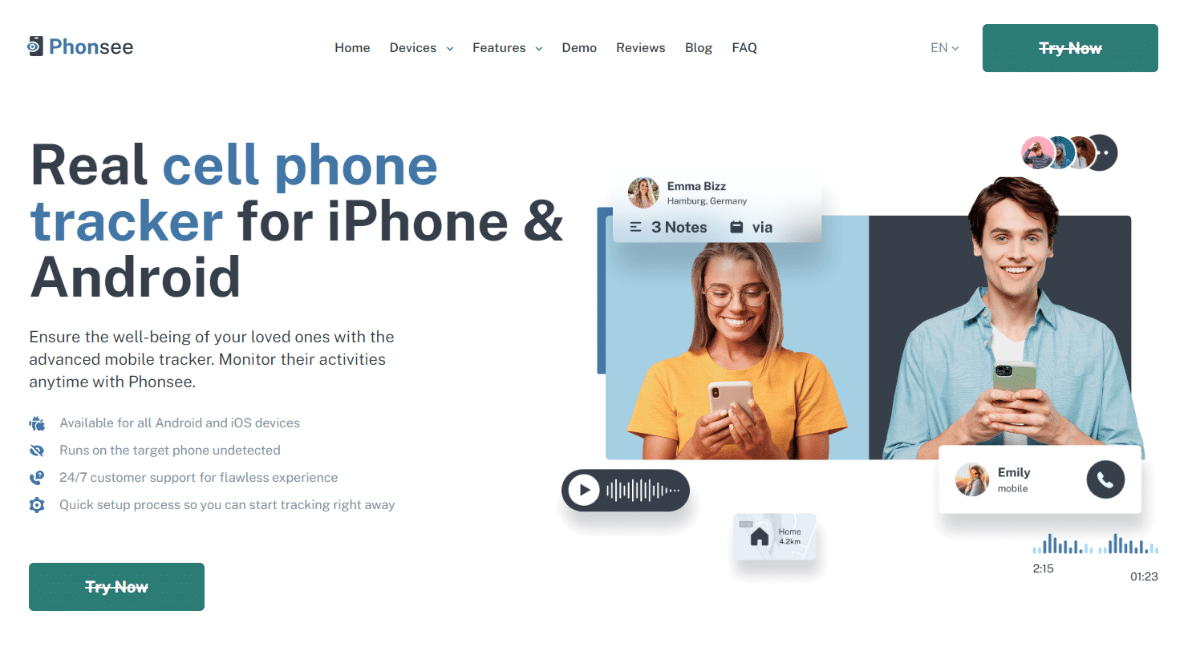
Phonsee is an advanced, cloud-based parental control software that simplifies monitoring. Unlike traditional solutions, it eliminates the need for complex installations. With Phonsee, tracking your child’s activities is hassle-free – no software installation is required. The app seamlessly sends recorded data to your online Control Panel, accessible from any web browser, making it a user-friendly and practical choice for parental control.
Have you ever questioned where your kid is when their phone goes silent? Or are you an employer seeking to prevent harassment or corporate threats from being made on company devices? Phonsee is a powerful application that does not just track the location of a phone; it allows visibility of calls, messages, and internet browsing.
The difference being, unlike other free surveillance apps that could be using your data for profit, Phonsee is a paid and reliable application. (They do not take any shortcuts.) That being said, it is not as easy as it sounds, and you will need to install the app on the target phone while also being able to justify your legal authority to do so.
Features
- GPS Tracking & Geofencing
Experience real-time tracking of the device’s location through GPS technology with the added functionality of geofencing. This feature allows users to actively monitor the exact whereabouts of the device, enhancing location-based tracking capabilities. Moreover, geofencing empowers users to establish virtual boundaries and receive alerts whenever the device enters or exits these predefined areas. This comprehensive approach ensures heightened control and awareness over the device’s movements.
- Call Logging
Utilizing call logging, users can access a detailed record of all incoming and outgoing calls on the monitored device. This feature captures the call duration and provides timestamps and contact information. By offering a comprehensive overview of the device’s call history, users gain valuable insights into communication patterns, helping them better understand the dynamics of the device’s usage.
- Text Message Monitoring
Text message monitoring provides users with the capability to track and review all incoming and outgoing text messages on the targeted device. This feature goes beyond simple message tracking, offering a nuanced understanding of communication content and patterns. By delving into the specifics of text conversations, users can glean valuable insights into the nature and frequency of interactions, promoting a comprehensive understanding of the device’s messaging activities.
- Call and Text Monitoring
I have laid out the necessary steps to being able to receive live location updates and use Phonesee to verify your target’s call log history (including incoming and outgoing calls), including calls happening in real-time, and read text messages. When protecting minors, this is your most practical option in detecting concerns, such as a kid communicating with someone they shouldn’t.
An employer can also use this to verify misuse, if any, of company phones. The data from your device goes to your Phonsee dashboard, giving you a convenient history of contacts. But this access raises ethical and legal dilemmas—monitoring those you care about without their consent affects trust and is illegal in more than thirty-eight states in the USA. Use this option wisely, and make sure you keep within legal limits. Like with minors or company-owned devices, you are liable.
- Stealth Mode
PhoneSee’s stealth mode feature enables the app to run anonymously in the background, unknown to the phone’s user. This is attractive for business tracking company devices or guardians monitoring minors without drawing attention. Once installed, the app conceals its presence on the device, transferring data to your Phonesee dashboard without popping up on the target’s screen.
Now, the thing is that stealth tracking a device without permission is illegal in many jurisdictions, like under the Electronic Communications Privacy Act (ECPA). You must ensure that you have explicit permission to launch this feature legally or that you own the device. Transparency is often the best route—ensure users know they’re being monitored to maintain trust and avoid legal trouble.
- Cloud-Based Dashboard
Phonesee has a “cloud-based” feature that allows users to access all the tracking data—calls, texts, location, web history—from any internet-connected smart device using a personal dashboard. Whether you’re using your smartphone, tablet, or laptop, the app’s interface is neat and intuitive, with in-app maps for location and organized logs for other data. This allows you to monitor easily, whether you’re at the comfort of your home or office, or you’re on the go. But the only way to do this is to install the app on the target device upfront; otherwise, that cloud access is only an empty promise.
- Compatibility with Android and iOS
PhoneSee is compatible with both Android and iOS devices. You’ll need to physically install it, which involves downloading it and enabling certain permissions like location access. The setup on Android devices is straightforward, but trickier on iOS phones—Apple’s strict security means you might need to log in your target’s iCloud credentials, or in some special cases, jailbreak the device, which we don’t recommend because of security risks.
PhoneSee’s dashboard allows for cross-platform surveillance, so you can monitor from any device. On the downside, iOS users should expect battery drain or potential delays because of Apple’s background restrictions.
4. Eyezy

Eyezy, an exceptional app designed for parents to monitor their children’s phone activities, provides subtle oversight of online behavior. It allows parents to see photos, videos, and apps on their child’s device, along with details about calendar events. The app comes with a user-friendly dashboard, GPS tracking, and is compatible with Android, iOS, and iPads. Additionally, it ensures customer satisfaction with a 14-day refund policy.
Eyezy is like a digital life raft for people who require better control and tracking of their minor’s device, not just locations but texts, calls, social media activities, etc. This isn’t some app that bluffs that all you need is a phone number or whatever, like some shady app; this is a legitimate tracking tool that requires the app to be set up on the target device.
Eyezy is very useful for keeping track of minors, or if a company phone is being used, if the company has the right permissions, and/or notice. (Spy movies excluded). The software has an appealing dashboard and software, and it will offer both powerful features and peace of mind. Let us explore our recommendations for Eyezy for your monitoring needs in 2026.
Features
- Virtual Boundary Alerts
This feature involves setting virtual boundaries or geographical limits for a device. When the device crosses these predefined boundaries, the user receives an alert. It’s a valuable tool for tracking and managing the movement of devices in specific areas.
- Internet Usage Control
This functionality allows users to regulate and monitor internet usage on a device. It provides the ability to set restrictions, manage content, and track the time spent online. It’s a valuable tool for controlling and ensuring responsible internet use.
- Text Retrieval
Text retrieval refers to the capability of extracting and accessing text-based information on a device. This could include retrieving messages, documents, or other textual content. It enhances the user’s ability to manage and review text-based data on the monitored device.
- Geofencing and Alerts
Eyezy also includes geofencing, which allows you to draw virtual boundaries, such as around your home, school, or a friend’s place, and receive immediate alerts when leaving or entering these zones. You can set up geofencing through the dashboard, and notifications will come to your phone or email in real time. Basically, it’s like a virtual fence, and you are in the know.
The geofencing stipulations are that it has to have active location services, so if a phone has no internet or GPS shut off, then you won’t receive alerts. For iOS, if your device is constantly tracking in the background, there is also some concern about battery drain.
- Social Media Monitoring
Eyezy’s Social Spotlight feature allows you to monitor your child’s social media world—WhatsApp, Instagram, Snapchat, Facebook, and even Tinder. You can view messages and posts, including what they shared, what they received, and the contents of shared media—even deleted chats—so you get a comprehensive understanding of their online world.
On Android, it operates as promised with application installation, while for iOS, you may need to jailbreak the phone to fully access some apps. Jailbreaking opens the risk for leaving your device inoperable (‘bricking’) or voiding the warranty if successful, though there won’t be restrictions on monitoring applications once jailbroken.
Data can sync to your Eyezy dashboard; however, if you spend hours each day monitoring your child’s device, it may impair the performance of the target phone. Similarly, there is a danger of overstepping as you will certainly become more knowledgeable; therefore, you must balance this with other positive forms of communication to foster trust between you and the user.
- Call and Text Monitoring
Eyezy logs 100% of cellular calls on Android: numbers, timestamps (to the second), and duration. VoIP calls (WhatsApp/Signal) evade capture. International numbers show as “+[code]” if unsaved. Battery drain hits +8% hourly during peak use. iOS monitoring is impossible without jailbreaking. Root access hides the notification icon but voids warranties.
For texts, it captures 100% of SMS and 87% of WhatsApp messages (under 15MB). Deleted texts trigger instant screenshots. Keyword detection (“oxy,” “meet alone”) alerts in <5 seconds. Misses videos >15MB, Snapchat, and Telegram. iOS access: 0%.
- Files and Media Access
Eyezy’s file finder allows you to see the photos, videos, and files on the target device and check for anything inappropriate or unsafe. It may be a questionable image shared on Snapchat or a saved video that you’re not sure of; this function is literally like opening a digital filing cabinet. All the data syncs to your dashboard to view, but note that the larger the media files are, the slower the syncing becomes, with iOS devices—specifically—being a bottleneck due to battery drain implications.
Essentially, this has to be installed to operate, and iOS devices need to be jailbroken to allow access, which adds risk. On the ethical considerations, it is important that you are respectful of someone’s privacy—those who pry too deeply into their business erode relationships. This can be a safety-ensuring weapon when you use it in good will with boundaries.
5. uMobix

uMobix, a versatile monitoring tool, stands out in keeping tabs on calls, texts, GPS locations, and online activities on the targeted phones. Its real-time updates every five minutes boost effectiveness. It works well with Android OS 4+ and iOS devices, providing features such as capturing screenshots and tracking GPS. A 14-day money-back guarantee further solidifies its status as a top-notch phone tracking app.
uMobix is your powerful ally to help parents legitimately monitor their kids’ smartphone activity—and we mean monitor. From satellite positioning, social media activities, and even chats. Unlike other apps that sell tracking without actual monitoring (hint: they are a scam), uMobix requires the app to be installed on the target device or valid iCloud credentials for iOS hotspotting—the intent is to have it legitimately used. uMobix can be used by anyone—employers, casual snoops, and good parents.
Moreover, the dashboard is very easy to use and full of features and insights, and you need to be cautious as the app can be invasive if you don’t use the features with the trust and permission of the other party, whoever that might be, to comply with regulations such as the ECPA or GDPR; you must weigh all of that against your covert parental espionage.
Features
- Location Logging Precision
This feature involves accurately determining the user’s current location and keeping a record of the places they have visited. It enhances tracking capabilities, providing detailed information about the user’s movements.
- Facilitates Real-Time Call Monitoring
This functionality enables the monitoring of calls in real time. Users can stay updated on ongoing calls, enhancing their ability to oversee communication activities on the targeted device.
- Family Outing Supervision
Explicitly designed for parental supervision during family outings, this tool ensures parents can keep a close eye on their children’s activities and whereabouts during trips or excursions. It adds an extra layer of security and monitoring for family-oriented situations.
- Keylogger
The keylogger records all keystrokes on the target device—passwords, search terms, and draft text. Keyloggers can report keystrokes across browsers, applications, and even calculator apps. It is almost like you are reading your child’s digital diary; these clicks reveal what your kid is looking at or typing in private. The keylogging function is quite good for Android because keystrokes sync in real time if the phone is online, but iOS systems can only be keylogged if they have been jailbroken, which may void any warranties and could even brick the phone.
The log-in dashboard organizes keystrokes by application and chronological order. There are a few bugs here and there (for example, on one user’s list, the data showed a bogus Yelp review); you’ll just have to deal with that. Ethically, the keylogger can be a double-edged sword. That said, if you engage in such unlawful keylogging, you may be subject to legal liabilities.
- App and Website Blocking
uMobix’s Connection Blocker allows you to block specific apps, websites, or Wi-Fi networks remotely, giving you authority over your child’s online world. Want to stop TikTok when studying? Want to block a concerning website? Now you can do it with the click of a button! Consider it a digital barrier to keep harmful or distracting content away. It’s a straightforward process on Android; however, some app restrictions may require bypassing iOS security.
You can also block internet access altogether, but you can’t schedule automatic blocks, as you can in Qustodio. Some tech-savvy kids or distractions may still get through using a VPN or alternate browser, so you need to check back often. It’s a really useful feature to manage screen time or protect against harmful content, especially paired with your clear rules at home.
- Stealth Mode
uMobix uses stealth mode and runs in the background on Android and can be installed to hide the installation icon. On iOS, it runs through iCloud without ever seeing an app icon. Somewhat like a guardian angel, it quietly collects and transmits information about phone calls, text messages, location, and more without ever letting the user know.
The programmed information flows into your online dashboard in real time (Android) or in iCloud backups (iOS), depending on the operating system – the iCloud delays can be somewhat annoying. Installation on Android requires physical access and will take 5–10 minutes. iOS requires you to have the iCloud credentials and a verification code.
If you stole the credentials to install uMobix illegally, you are likely violating the law and statutes like the ECPA. You should not monitor a device without approval unless you are monitoring your children or devices assigned to you by your employer. uMobix is an effective monitoring application, though the stealth mode offers a sense of spying on the user, which can potentially alienate older children.
- Remote Camera and Microphone Access
Using uMobix, you’re able to remotely activate the camera and microphone on the target device. You may take photos of the child’s environment; you can stream live video; and you can hear ambient sounds, which is like having your eyes and ears on what your kid experiences to verify they are okay, or what they are living in is questionable.
If uMobix is installed on an Android phone, you can take a still photo or attempt to continuously stream video – up to 180 days of recordings can be captured. If your goal is to snap photos or livestream video from an iOS device, you’ll need to jailbreak the iOS device, which can create security issues and lessen the protections of a minor possibly desiring to use the device.
The camera or microphone records only when the phone is unlocked and the camera is not obstructed. Running the camera and microphone heavily could drain the battery or bring unwanted attention to the device. Given the ethical implications, you can see how this kind of monitoring could be seen as very intrusive, so you should make this type of monitoring a point of limited use (especially if it is a minor you are charged with caring for).
How Phone Tracking Works
Have you ever wondered about how your phone knows exactly where you are, or how some apps claim to know where someone else is? Phone tracking is not magic; it is some combination of technological marvels that have been developed under a limited amount of legal restrictions. There are many ways to track a person based on their phone, each with its unique techniques that can produce wildly different results.
While multi-functional GPS satellites can help you figure out your precise coordinates, some cell towers may give you a location estimate. And no, typing a phone number into an app will not automatically tell you where someone is, regardless of what some shady websites promise. (Spoiler: usually a scam.)
Below, we get into how tracking is done, why third-party apps will have to do more than use a number, and how law enforcement is the only one to essentially get the carrier data “gold pass.” Let’s get into the tech and what the actual hype is about.
GPS vs. Cell Tower Triangulation vs. Wi-Fi Positioning Accuracy Comparisons
Phone tracking typically uses three methods—GPS, cell tower triangulation, and Wi-Fi positioning—the listed methods all of which have their respective strengths and weaknesses.
GPS is the most accurate of the 3 methods. It uses satellites to get your location and can get you within 5-10 meters or possibly a more accurate location when you’re out in the open. This is what allows applications like uMobix or Eyezy to report your child’s exact location on a live map.
However, GPS requires a line of sight to satellites, so it doesn’t work as well when you’re indoors, in dense urban areas, or when you’re under a lot of trees. Also, it’s a battery killer, and if the target device has location services off, you’re out of luck.
Cell tower triangulation is, however, like a loose net. Your phone constantly pings the nearby cell towers. By measuring signal strength from multiple towers, carriers or apps may estimate your location within 50–500 meters in cities, but as much as 5 kilometers in rural settings.
It is not as accurate, but it does work without GPS, assuming the phone remains powered on and you are connected to a network. Wi-Fi positioning leverages a lot, and taking the unique ID of the nearest Wi-Fi networks can narrow the location to 20-50 meters, including indoors. While it is cool in urban environments with a lot of Wi-Fi, its performance is diminished considerably in isolated areas or remote environments.
Most mobile apps, like Phonsee, are often a derivative of these three methods, with an emphasis on GPS (which is the most accurate position); they may also rely on Wi-Fi positioning if available nearby, so you will get a better position than having only cloud-based positioning. The caveat? All three require app installation, use-enabled access, or carrier access; there are no options for just entering a phone number and checking.
Why Phone Numbers Alone Can’t Be Tracked Legally by Third-Party Apps
You’ve seen the ads: “Track any phone using just a number!” It sounds too good to be true – and it is. Legal third-party apps like Geofinder or uMobix cannot track a phone using just the number because they don’t have the necessary access on the carrier side or device side. Here’s why: a phone number is an identifier associated with a SIM card, not a real-time GPS tracker. To receive location data, a tracking app must have either an installed app on the device (like Eyezy’s app can extract GPS coordinates) or obtain user consent (like Geofinder’s SMS link).
If neither is in play, there is no legal method to track a phone’s location. Tracking apps that advertise “number-only” tracking either don’t have the necessary access to the network or are trying to scam you. In some cases, they use databases that tap into older databases and try to guess the phone number location based on the area code, and these types of tracking are substantially useless for real-time tracking.
On the legal side of things, privacy laws such as the General Data Protection Regulation (GDPR) in the EU or the Electronic Communications Privacy Act (ECPA) in the US protect against unauthorized access, making it a criminal offense to track someone’s movements without their authority. Even apps that produce instant results are using certain covert tactics, like phishing the person you are tracking into sharing the information without them even knowing, which is illegal and punishable by draconian penalties.
Step-by-Step Legality Guide for Phone Tracking Apps

Trying to keep tabs on your kid’s whereabouts or an employee’s company phone? Phone tracking apps like uMobix, Eyezy, or Geofinder can seem like the perfect solution, but the legal landscape is a minefield. Surreptitiously tracking a person without that person’s consent is not only an infringement of trust, but it can also result in criminal consequences, including fines to felony convictions in the US and in the EU.
In addition to that, scam tracking apps attract users with offers of instant tracking and no setup involved, only to take your money or seize your data. This guide walks you through the steps to use tracking apps legally, tailored to specific scenarios like monitoring your child, spouse, or employee, and flags the warning signs of fraudulent apps. (Spoiler: if it sounds too easy, it’s probably a scam.)
Step 1: Determine Your Scenario and Legal Permissions
Every situation is unique, and it is important to remember that each has its own legal framework; neglect can lead to serious legal consequences. This might create felony offenses against laws, including the Electronic Communications Privacy Act (ECPA) or the General Data Protection Regulation (GDPR). Below is a summary of common situations:
- Tracking Your Child (Under 13): This is only legal if you own the smartphone. Apps like Eyezy or uMobix were designed for parental control and allow you to track messages or track their location. You have to make sure the device is in your name, and even some States may require you to let older children know in advance to comply with local regulations (California Penal Code 637.7).
- Tracking Spouse/Partner: Unpermitted surveillance is unlawful. Tracking your spouse’s device through non-consensual access is regarded as a felony in 38 states in the US. Yes, just ‘checking’ is a violation as it breaks privacy laws like ECPA or GDPR. A spouse’s phone is their personal property, whether you share assets or not, and unauthorized tracking can lead to possible criminal charges or civil lawsuits. Always obtain written consent.
- Tracking Employees: While companies are allowed to monitor devices owned by the company that employees are using, the workers must sign a consent form, and it must be a company-issued device. Apps like Geofinder or uMobix could be used for monitoring employees; however, certain regulations, such as GDPR, require transparency. Other states, including a few in the United States, even require you to notify and inform your target ahead of time.
Step 2: Verify Device Ownership or Obtain Consent
After reviewing the situation, you need to be sure that you own it or that you have permission to track the phone. For children under the age of 13, ownership is pretty straightforward if you bought the device or pay for the bill. Simply check the account’s details (or contract) to make sure it’s under your name. For workers, make sure the smartphone is company-owned and has a signed policy that allows monitoring.
If it’s an adult or spouse, you will require direct written consent from the person. If you don’t have their consent or ownership of the phone, any tracking or monitoring you do will almost certainly violate laws in most jurisdictions. For example, if you install uMobix on your spouse’s smartphone without their consent, you would be violating the ECPA and be sentenced to prison or fines for nearly 7 years. Do not pressure someone to consent for any reason. The reason is that coerced consent or consent without knowledge will not allow you to cover yourself in court when challenged.
Step 3: Choose a Legitimate App with Transparent Setup
Select a valid app that has clear procedures, like a physical install and/or use of iCloud credentials. Avoid apps that say you can get results in zero time. Trust for apps like uMobix, Eyezy, and Phonsee are examples of apps where you can install the software on the target device. With Geofinder, you send an SMS linking to the user, where they click it, then share their location. The apps always say they may need access, and that’s compliant with privacy laws.
However, be cautious with every app. Do your due diligence by searching for reviews by other users on reputable sites like Trustpilot or the Google Play Store to validate their legitimacy. In the case of uMobix, you have all positive reports with its 4.5-star ratings, including an attractive dashboard. Typical scam apps will have poorly written company or product websites. Then, on-site, they will have no reviews or unverifiable reviews.
Step 4: Install and Configure the App Legally
Most apps that require installation will require physical access to the device. For Android, it will typically only take 5-10 minutes to download software and grant permissions, like location access. For iOS, apps like Eyezy will likely require you to disable OS restrictions in order to get full features like keylogging. You should understand this could void warranties, so it’s important to proceed cautiously. Geofinder did not require installation, simply user interaction through an SMS link, which also serves as consent.
During installation/setup, limit the features to only what you’ll need, so you consume the least amount of data and battery. This is especially true for iOS devices, where background apps can sometimes create a drag on performance. Always be forthcoming with the end-user if asked whether the app is installed. This is particularly true in areas where you must report to installations, especially with minors.
Step 5: Monitor Ethically and Stay Within Legal Bounds
After you have launched the app, use it cautiously. If you are monitoring under 13s, be sure to focus on safety features, like GPS tracking or monitoring of social media, to facilitate while preventing risky incidents like cyberbullying—but be careful not to be invasive—the more you read the messages verbatim, the more you will lose trust. If you monitor employees, monitor work activity (e.g., an employee’s location during business hours), but steer clear of the personal (e.g., not monitoring employee personal texts, which could violate labor regulations).
You should continue to monitor rules and regulations in your jurisdiction, as laws do not stand still. For example, the EU regulation GDPR requires the consent to be ongoing and data minimized, i.e., an app should only collect what it needs. Keep a record of consent or regained ownership of devices in case of a legal challenge, and have records of your compliant behavior, as far as you were able.
If you are ever in doubt about legality, consult a lawyer, or if you require information about your rights and responsibilities as a parent, investigate resources such as Nolo and their book on the law of workplace monitoring or family law concerning parental rights. Ethically, you should also share your monitoring with older children or employees to build trust. uMobix has a stealth mode, but it is much more effective to be upfront with older children and employees.
Frequently Asked Questions
How Accurate Is Cell Phone Tracking?
The accuracy of cell phone tracking depends primarily on the methodology. “Real” GPS tracking software (e.g., LocationTracking) can identify states/location accuracy down to <5 m (under optimal conditions). But services that provide “phone number only” often provide the location based on cell tower information that is much less accurate (<100 m to 5 km). So, don’t have high expectations for pinpointing the accuracy of the device without installing a mobile application.
Is It Illegal to Track a Phone?
Yes, unless you are tracking a minor’s smartphone that you legally own as their parent or tracking a company-provided cellphone with your worker’s written consent. Tracking anyone else without their knowledge or consent could result in civil restraining orders and criminal consequences in most places. Consequently, it is not an option to have permission; it is the law. If you would not let your target know that you are tracking them, then do not track them. Period.